ETS – Emergency Trip System Monitoring
The Emergency Trip System (ETS) is used for monitoring trip conditions by Trip Push Buttons (TPB) at multiple locations along the rail track. Trip Push Buttons are used for tripping the two adjacent substations and deenergizing the feeding power of a rail track section in case of an emergency. A phone is used to communicate directly with the dispatch control center and report an emergency in the track.
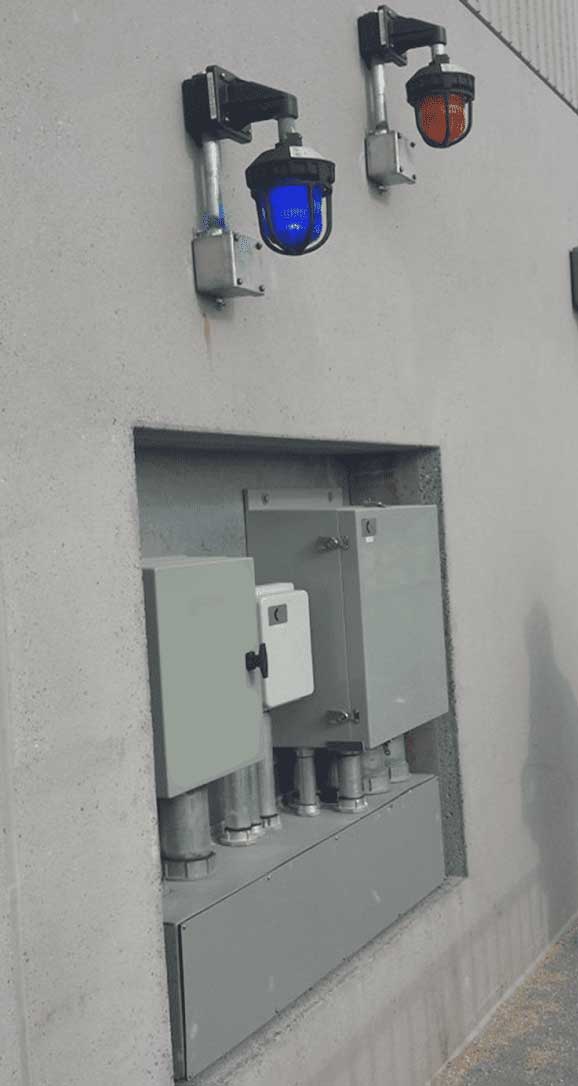
The system monitors TPB coil voltage, current trip status and the general health of the ETS equipment installed along the track. Bright blue LEDs always show the location of the ETS unit along that section and a flashing amber LEDs shows train drivers the presence of a work crew on a track section.
The status conditions of each ETS unit along the track and the fact that personnel are present on that section of line are relayed to the nearest ePAQ data concentrator for local display (via touch screen HMI) as well as relaying this information to the central SCADA Operations Center.
- Works With Distributed DIO Modules for Trip Condition Monitoring, Hardware Fail Alarms and Worker Presence Warnings
- Monitors Safety Shutdowns of Feeders
- Local Amber/Blue LED Indicators for Announcing ETS Unit Location and Safety Indication of Personnel Being Present
- Notifies Nearest Data Concentrator and SCADA Master Station of Current Trip Condition
- Redundant Communications for High Reliability
- Supports IEEE Standard DNP3 Protocol
- Status Changes are Time Stamped via Distributed I/O Clock
- 19″ Rack or Panel Mountable
Communication
-
Operations Center signaling of a Trip Condition via a IEEE Standard protocol, DNP 3
Level 2.
- Substation signaling warning notification at each end of the Track Segment.
- Redundant communication channels for reliability of data.
- USB Maintenance Port for easy configuration and local monitoring.
- Communication over many media options (Fiber, RS-485, CAT5e) in one module.
Capabilities
- IRIG-B Time Interface, designed to provide time synchronization, time stamping of all events and sequence of events (SOEs).
- Local & Remote Switch for safety, disengaging controls when onsite service is taking place.
- Light Indication (Blue & Amber) logic/intelligence to signify trackside as “clear” or “occupied”.
- Controls work with a “select-before-operate” (SBO) to avoid misoperations.
- “Broken Wire” detection made possible by the topology of the ETS Controller Network.
Physical
- Ruggedized for trackside conditions
- Tested to IEEE standards; C37.90.1-2000
- Temperature ranges to -40 to +85 degrees C, 5 to 95% humidity (non-condensing)
Power
- 12 Vdc, 125Vdc, 120Vac, 277 Vac.
What Our Customers Have to Say
It’s Easy to Get Started
STEP 1:
Schedule a Consultation Call
Let’s talk through your goals and what your current infrastructure looks like.
STEP 2:
We’ll Collaborate to Develop a Solution
We’ll develop a plan to modernize your infrastructure to meet your goals.
STEP 3:
Experience the Advantages of QEI
We’ll coordinate and execute the plans for your upgraded system.

 English
  Spanish